Laboratory Analysis vs. Calculated Nutrition Values: What Food Businesses Should Know
Learn how laboratory testing and calculated nutrient values differ, where calculated data comes from, and how each method may support Nutrition Facts preparation.
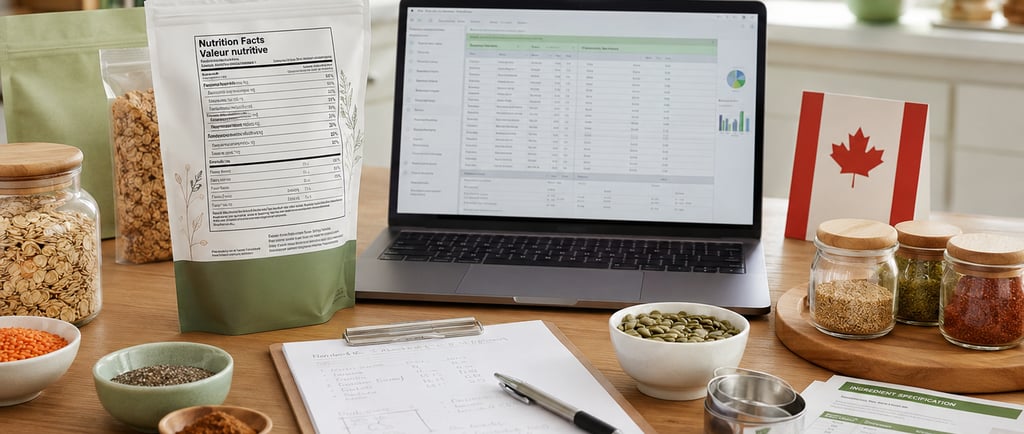
Learn how calculated nutrient values differ from laboratory analysis, what information each method uses and how Canadian regulators assess Nutrition Facts table accuracy.
Understanding the Two Main Methods
The cost of preparing a Canadian Nutrition Facts table depends partly on how its nutrient values are determined. Two principal approaches are available:
Calculation from recipe and ingredient information
Laboratory analysis of the finished product
Both approaches can produce suitable nutrition information when properly selected and completed. The best method depends on the product, the quality of the available information, its manufacturing process and the degree of verification required.
What Does a Canadian Nutrition Facts Table Cost?
Pricing depends on the complexity and number of products, the completeness of the ingredient information, serving-size determination, label claims, bilingual requirements, compliance review and whether laboratory testing is needed.
For a straightforward product with complete and usable documentation, our calculated Nutrition Facts table service starts at CA$75 per panel. Laboratory testing, complex formulations and additional label-review services are quoted separately.
Where Do Calculated Nutrient Values Come From?
Calculated nutrient values may be developed using reliable information from several sources, including:
Supplier ingredient specifications and certificates of analysis
Nutrition information supplied by ingredient manufacturers
Health Canada’s Canadian Nutrient File
USDA FoodData Central
Other recognized food-composition databases
Published scientific and technical references
Recipe quantities, finished-product yield, moisture changes and applicable nutrient-retention information
USDA FoodData Central is an extensive public food-composition database maintained by the U.S. Department of Agriculture. It contains nutrient data for basic commodities, commonly consumed foods and many food ingredients. It can be particularly helpful when suitable information is unavailable from suppliers or Canadian data sources.
The selected database entry must closely represent the ingredient actually used. Differences in variety, processing method, moisture content, fortification or geographic source may affect nutrient values. Canadian requirements—including permitted units, rounding rules, serving sizes and label format—must still be applied when preparing a Canadian Nutrition Facts table.
The Canadian Nutrient File contains food-composition information compiled from Canadian sources and data adapted from USDA nutrient databases. Health Canada presents it as a Canadian food-composition reference, while USDA FoodData Central is the current U.S. public food-composition resource.
Laboratory-Analysed Nutrient Values
Laboratory analysis measures nutrients in samples of the finished product. Representative samples are sent to a qualified food laboratory, where selected nutrients are measured using recognized analytical methods.
This approach can better reflect the product as manufactured, including the effects of:
Natural variation in agricultural ingredients
Processing and cooking
Moisture gain or loss
Ingredient substitutions or seasonal variation
Differences between production batches
Laboratory analysis is generally more expensive because numerous individual tests may be required to obtain all the values displayed in a Nutrition Facts table. Sample preparation, shipping and laboratory turnaround time must also be considered.
Is Laboratory Analysis Always More Accurate?
Not necessarily. Laboratory testing measures the samples submitted, but those samples may not represent every production batch. Results can also be affected by sampling procedures, natural product variation and the analytical methods used.
Calculated results can be highly reliable when the formulation, ingredient data, finished yield and processing information are accurate. However, even a sophisticated calculation cannot compensate for incomplete recipes, outdated specifications or incorrect yield information.
Accuracy therefore depends on more than the selected method:
Laboratory results depend on representative sampling and suitable analytical methods.
Calculated results depend on complete formulations and dependable source information.
Both depend on consistent manufacturing and careful technical review.Write your text here...
Are Calculated Nutrient Values Acceptable in Canada?
Canadian food-labelling requirements do not generally require every Nutrition Facts table to be based on laboratory analysis. Declared nutrient values may be supported by appropriate laboratory data, reliable ingredient information, recognized food-composition databases, calculations or a combination of these sources.
Regardless of the method used, the manufacturer or importer is responsible for ensuring that the label is accurate and that declared values meet applicable Canadian compliance tolerances. Neither a calculation report nor a laboratory report constitutes government approval of a label.
When Should Laboratory Testing Be Considered?
Laboratory verification may be advisable when:
Ingredient nutrient information is incomplete or unreliable
The product contains naturally variable ingredients
Processing substantially changes its nutrient composition
A nutrient content claim requires closer confirmation
Nutrients are added through fortification
The product’s actual composition may differ materially from its calculated formulation
A customer, retailer or regulatory authority specifically requests test results
A combined approach may also be used: values are initially calculated from the formulation, while selected nutrients are laboratory tested when additional confirmation is warranted.rite your text here.
Choosing the Appropriate Method
For many standardized foods, recipe-based calculation provides an efficient and economical basis for preparing a Canadian Nutrition Facts table. For highly variable products or products requiring additional verification, laboratory analysis may provide valuable supporting evidence.
Before recommending either method, the product formulation, ingredient documentation, processing conditions, finished yield and intended claims should be reviewed. This helps determine the most appropriate and cost-effective approach for the product.
Send us your complete recipe, ingredient specifications, finished yield, serving information and a brief description of the manufacturing process. We can review the information and advise whether calculated values, laboratory testing or a combination of both would be appropriateWrite your text here...
This article provides general information only and is not legal advice. Requirements depend on the product and intended market. The manufacturer or importer remains responsible for ensuring that label information is accurate and compliant.
Nutrition Facts Expert Canada
Unit 18, 12484 82 Avenue
Surrey, BC V3W 3E9
Canada
Contact
604-583-6007
info@nutritionfactsexpert.ca
Nutrition Facts Expert Canada
Nutrition Analysis and Food-Labelling Support for Canada and the U.S.
© 2026 Nutrition Facts Expert Canada. All rights reserved.